diatom.org
Marginalia
Education


FAQs

Software

Feedback

Donations

About Us


Unactivated
links are
grayed
.


<

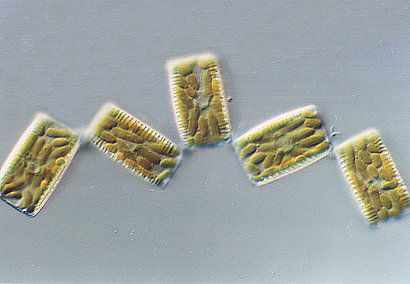
Diatoms are a group of unicellular, photosynthetic microorganisms well-known for displaying an intricate and wonderous architectural beauty. However, there is more to a diatom than simply its pretty face. As a major branch in the tree of life, over the past 200 million years they have evolved a complex mosaic of genetically based metabolic talents and generated a species diversity rivalling that of flowering plants. Additionally, diatoms have evolved to become global players in recycling life's critical nutrients, influencing the composition of the earth's environments and powering the planet's aquatic ecosystems, as well as elucidating their history.

diatom.org is a non-profit organization seeking to promote a public awareness and appreciation of diatom ecology and evolution across a broad range of age groups by providing information about diatoms and public involvement in their scientific study.

Above: Light microscope serial-focus and composite images of the glass cell wall of the diatom Asteromphalus from the Bering Sea (specimen in Farlow Herbarium, Harvard University) and the 3-dimensional spatial distribution of elementally different metal atoms in a single cell of the diatom Cyclotella (the latter from M. D. de Jonge et al. 2010. Proceedings of the National Academy of Sciences USA 107:1576. More >).


Vermont Lakes

a calendar and census of diatoms and other phytoplankters in the lakes of northern Vermont

Lake Willoughby, Essex County, Vermont
.

Journal

original on-going online studies on fossil diatoms from the Baringo District of Kenya and the Menunketesuck salt marsh in Connecticut, USA

Marginalia

commentary and notes on diatom evolution and ecology and the history of their study


This site was last updated on 19 March 2012.

Scripts must be enabled in your browser to fully access all the parts of this website, to view our serial focus images and to make measurements on our images. We recommend Google Chrome (secondly, Firefox).

Creative Commons License
Creative Commons Attribution-NonCommercial-NoDerivs 3.0
Unported License
.
Cite any and all works on this website as derived from www.diatom.org